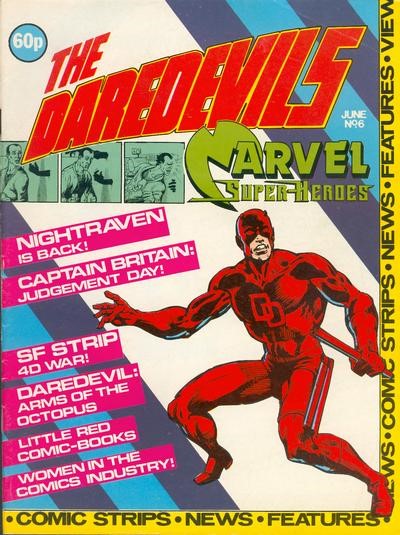
We are now travelling back to heyday of British Comics. There were probably more than 50 different UK based titles you could pick-up. 2000 AD was publishing Rogue Trooper, Skizz and Judge Dredd; Warrior was putting out Marvelman and V; the revived Eagle was giving us more Dan Dare and Doomlord; and we got new space adventures in Starblazer, among many other titles.
The Daredevils only had 11 issues but has a legendary reputation. It is not hard to see why. Around half the magazine is written by Alan Moore, still in the earlier stages of his career, whilst the title strip is Frank Miller’s acclaimed run. Add on to that art by Alan Davis and David Lloyd, and a feature on global comics from a young Terry Moore, it is like reading a “before they were famous”.
But does it deserve the reputation?
Starting with the biggest reason this is remembered, Alan Moore and Alan Davis’ Captain Britain.

Having not read this before I was not sure what I expected. Probably some British twist on Captain America, perhaps exploring the notion of Britishness, travelling around meeting character archetypes?
What I got instead is a surreal dark space adventure, analogous to Crisis on Infinite Earths, only earlier and orders of magnitude more interesting. As part of this experiment, I have not read the previous installments, so I am probably missing some parts. It turns out Captain Britain has been hopping between alternate universes. Saturnyne was sent to one such parallel earth where she was meant to increase the evolution of it, but it ended up being destroyed (possibly by Fury, a cyborg hunting down Cap). She is being put on trial for its destruction. As the court worries the blight from its destruction will threaten the omniverse so destroy that universe, which will also eliminate the evidence necessary to prove Saturnyne’s innocence. However, Fury survives and any blight there might be with him.
This is an incredibly complex and dense strip fitting into only 50 panels across 11 pages, but yet doesn’t feel rushed or rely on exposition. It is an incredible feat of comic book storytelling and I very much want to pick up the whole collection.
Next up, the first non-fiction feature by Alan Moore on women in comics. Apparently, this is the third in the series, with the previous two dealing with sexism in the industry and this one looking at women doing excellent work contemporaneously.
He runs through the few women working for Marvel and DC, calling out Mary Jo Duffy for praise, before concentrating on the pioneering work being done by women in underground comics, and then finishing by interviewing editor Bernie Jaye on what can be done to change the situation. All in all this is a really insightful and interesting piece I would be happy to read today.
After the letters column, we move on to Terry Moore’s piece on comic books in China.

In this he covers the success of Chinese “picture-story books” that are hugely popular and will commonly have a million-copy print-run per issue. He covers their development, the difference with Western comic books and how they use their artwork to great effect.
It is a really excellent and fascinating piece. The only thing I do wonder is how accurate it is, he admits how hard it is to get many of these comic books in the UK and when I checked out a subsequent issue for his piece on Manga, it contains many errors. For what it is though, excellent stuff.
After Alan Moore doing a review of two fanzines he has been enjoying of late (Catalyst and Fast Fiction), he then gives us a prose adventures of Night Raven.
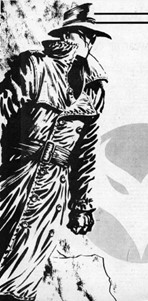
It is hard to summarise the plot because it seems more of a mood piece, like something you would expect to see Moorcock’s New Worlds rather than from a Marvel comic book. It is atmospheric and intellectual, but it also seems to me to have some unfortunate traces of orientalism. Perhaps one of those that works better as part of the whole.
After a lovely short profile on artist David Lloyd, we are on to reprints. Beginning with Daredevil: The Arms of the Octopus, from issue #165 and the first one where Frank Miller gets a co-credit as writer.

We do need to start with Frank Miller’s artwork here. It is just so dynamic and powerful, the only comparable figure I can think of at this point in comics history is Neal Adams. Even in black and white you can see his mastery here. This also shouldn’t undersell Janson’s inking which adds real definition to the scenes. In fact, without the colouring here it even more resembles the noirish atmosphere they would become known for.
The plot itself is a pretty standard one, dealing with the love triangle between Matt, Natasha and Heather, whilst Dr. Octopus tries to steal some Adamantinum to make himself some indestructible arms. But it is all in the telling. What could be trite becomes emotional and impactful.
I could go on but 1. I am keeping these short, & 2. These stories have been analysed by people better than me.
So, moving on to the final story, The 4-D War, another Moore/Lloyd collaboration. This time reprinted from Doctor Who Magazine.
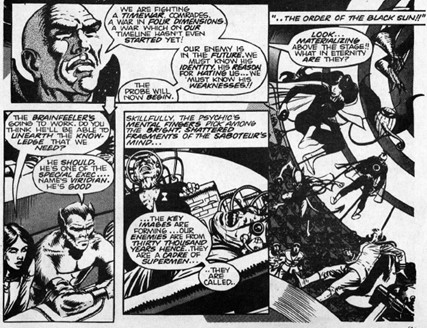
Whilst, on the one hand, reprinting something only a couple of years old from another Marvel UK magazine seems a little odd, it will likely be new to many comics readers as DWM probably appealed to a different market. What also makes this part particularly interesting is that this is the first appearance of Wardog, who is also key to the Captain Britain stories, linking this directly into the dimension spanning adventures of the Omniverse.
Set back in the days of Rassilon, the Time Lords had previously banished the deadly Fenris by sending him into the time vortex. They now seek to recover him in order to determine who hired him and why. Time Lady Rena-Du and Wardog together retrieve Fenris from the vortex and use a psychic to probe his mind.
They determine that he was sent from the future by The Order of the Black Sun as part of a war that hasn’t started yet. Before they can discover more, hostile people materialize above them and attack, destroying both Fenris and the psychic as well as many guards. Lord Griffen surmises that this is likely part of the 4-D war they are fighting. They may in fact be being punished for crimes they are yet to commit.
Once again Alan Moore is able to produce an incredibly complex tale, that would be of interest to people who have no familiarity with Doctor Who. Honestly without a couple of references you might not realize this is from the Whoniverse. Lloyd also continues to be on great form, with particularly impressive use of shadow and different art styles in a black and white back-up feature. Great stuff.
So that is the issue. Was it as good as its reputation suggested? Absolutely. A masterpiece of a comic book and such a shame it only got 11 issues before being merged into Mighty World of Marvel.
Next month, we’ll be going back to 1977 and children’s comic Toby #89:
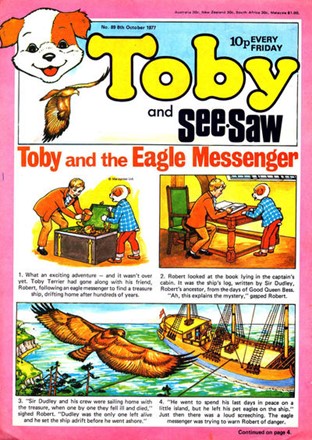
Will June’s installment it be as good as May’s installment? See you then to find out.
 Corner Shop Time Stop
Fun rundown, Marvel UK was on great form back then. I was always writing to the
lettercols, with gushing praise.
LikeLike