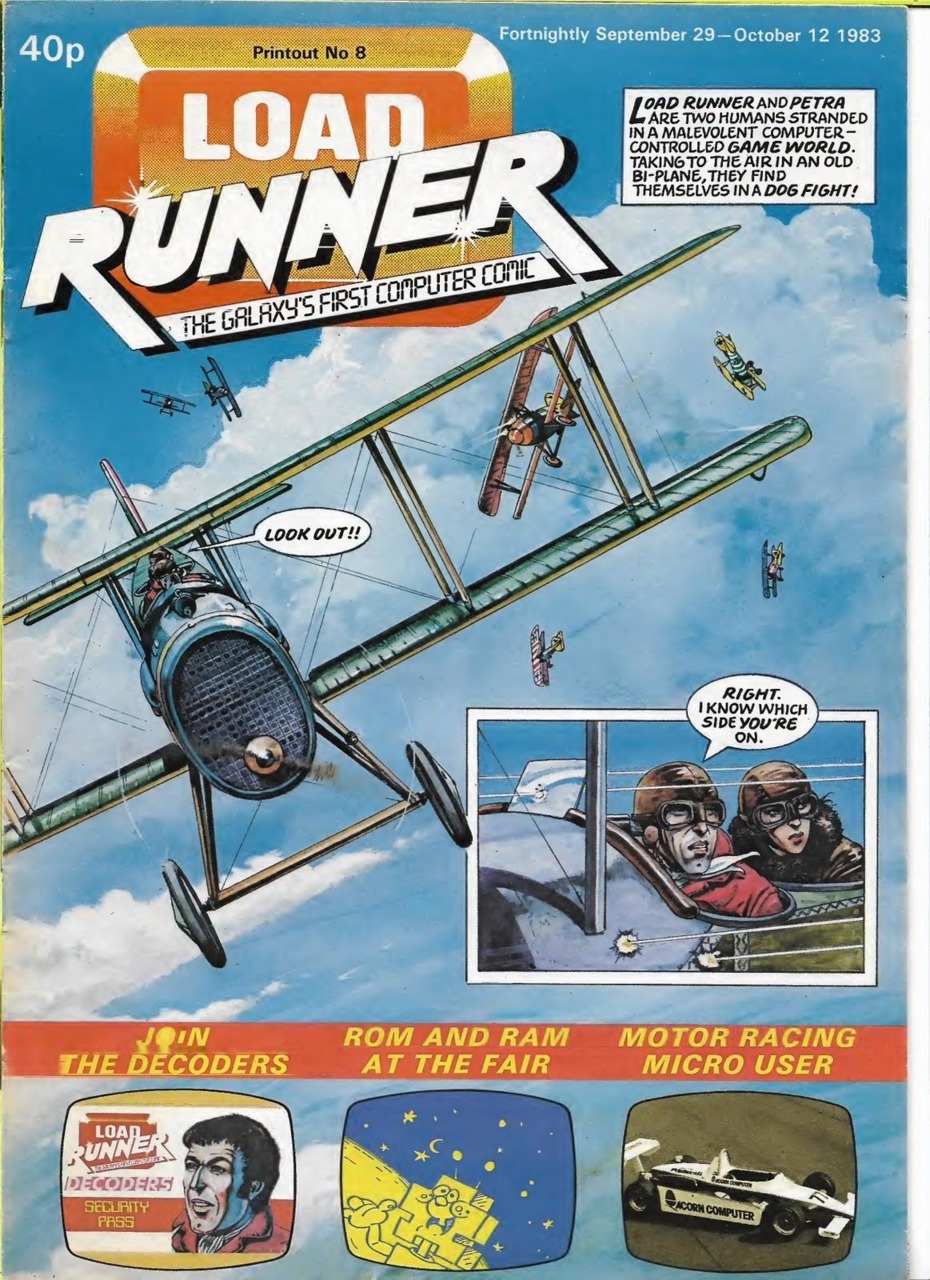
Load Runner #8 (12th October 1983)

Whip our your Ataris, as we go into the strange world of Load Runner.

I am fascinated with this series as it is a fascinating time capsule. It emerges out of both the early 80s comics revival and the first generation of home game consoles, trying to marketise the first as the latter was competing for young people’s attention. Yet this is already well into the 1983 video games market crash. Indeed, it would only last for 13 issues, already gone by the end of the year.

But what is it like inside?

Once again we are looking at a combination of different styles. Let us start with the traditional comic strips.

Comic Strips


The first of these, which also gets the cover is the titular Load Runner. Two humans that bounce between different video games in Gameworld. Each time they would have to beat the game before moving on to the next challenge. As such you would commonly see both the game view and how the heroes are experiencing it. This week in a World War I Flight combat simulator:
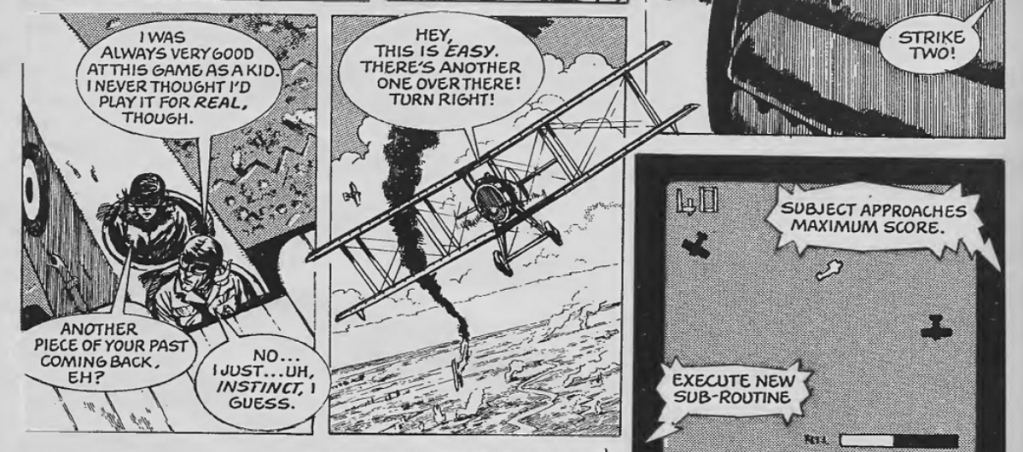
Three Panels across

Panel 1: Two people in an biplane:
Load Runner: I was always very good at this game as a kid. I never thought I'd play it for real. though
Petra: Another piece of your past coming back, eh?
Load Runner: No...I just...uh, instinct, I guess

Panel 2:
Long shot of the biplane
Petra: Hey, this is easy. There's another one over there! Turn Right

Panel 3:
View of an 8 bit flight game
Robotic Voice 1: Subject approaches maximum score.
Robotic Voice 2: Execute new sub-routine.

As the games are changed in each issue, it means there is not much scope for depth. It is more calling on the player to exercise their imagination when they are playing such games.

Next is Andy Royd – The Dominator’s Rogue Star!. This is an attempt to shoehorn in the ever popular subgenre of football stories into the magazine. It follows the usual tropes of a club and a player formerly with an injury trying to turn around their fortunes.

The twist in this one is these are robot players programmed by computers, with the titular player pretending to be a machine:
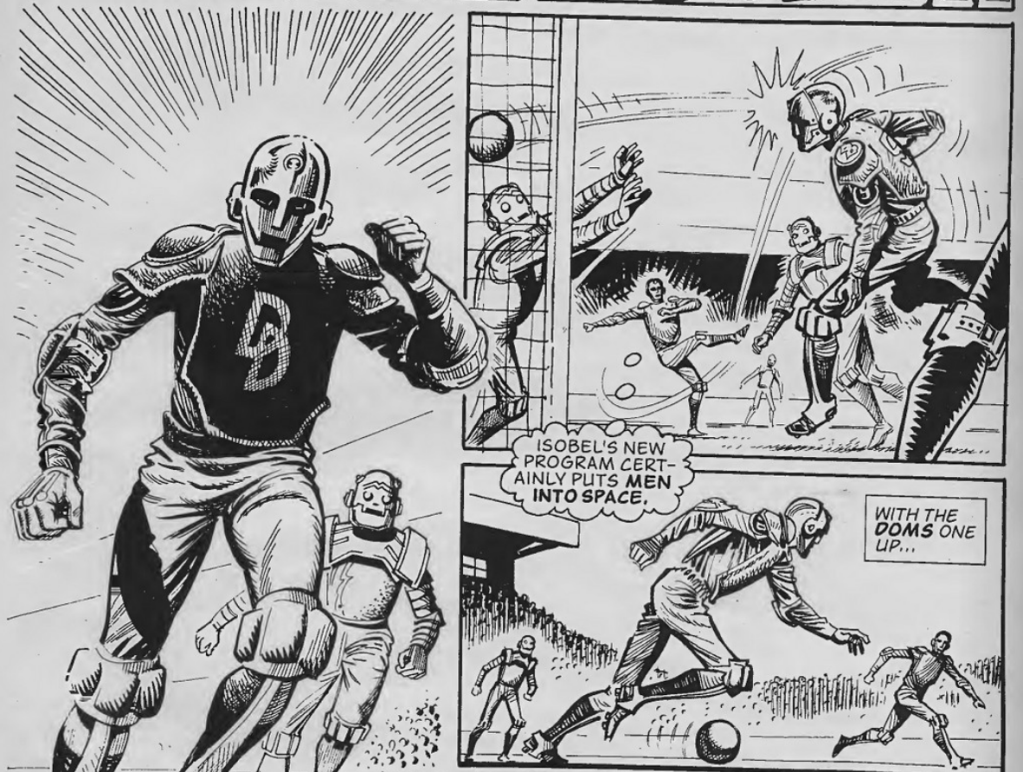
3 panels, one on the left, two on the right.
Panel 1: Person disguised as android running down the pitch
Panel 2: Same person headering in a football past a robot.
Andy Royd: Isobel's new program certainly puts men into space
Panel 3:
Gameplay continuing.
Caption: With the Doms up one.

As you can probably tell it didn’t really impress me.

Then there is The Invasion of the Arcadians, a computery spin on the secret alien invasion story. Here people are being controlled by an arcade game and turned into alien servants called Dazers. Teenagers Jo and D help take them down:
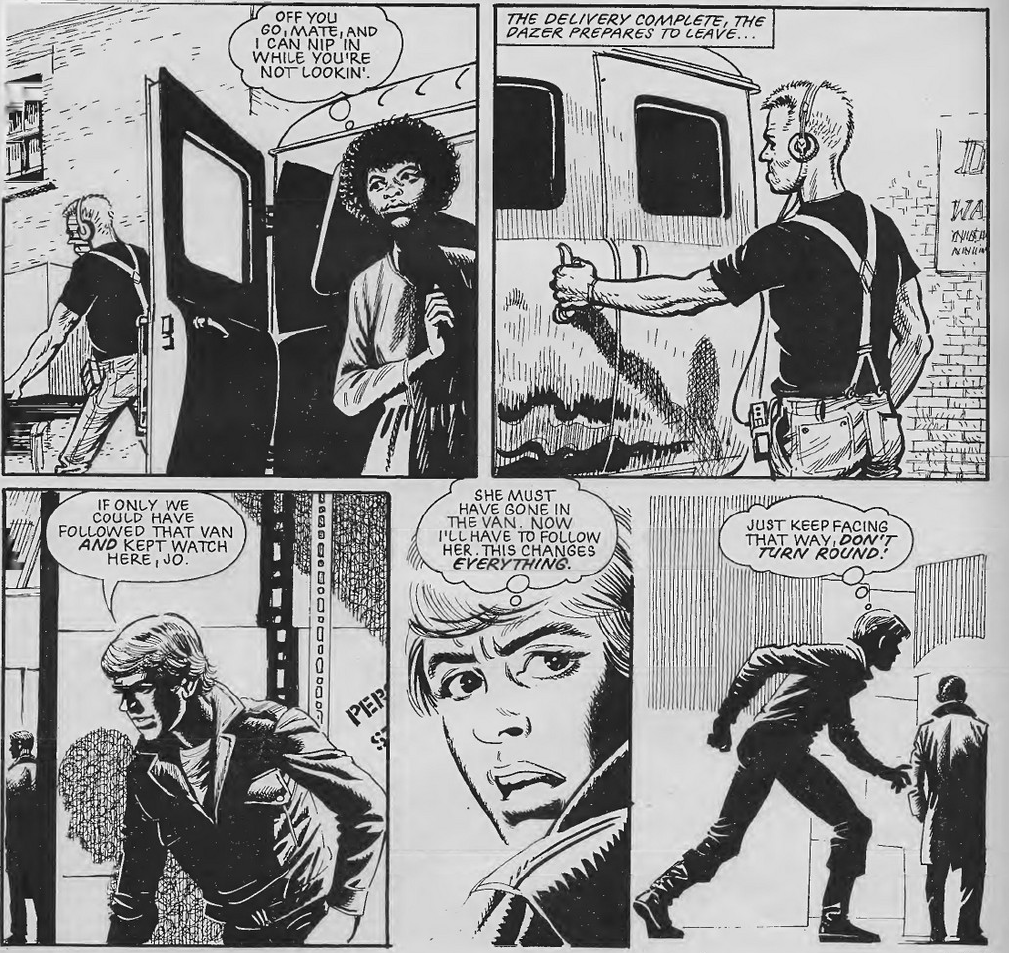
Five panels, two on top, three on bottom.
Panel 1: Jo watching Dazer unloading a van.
Aggie: Off you go, mate, and I can nip in while you're not lookin'.
Panel 2: Dazer closing the van.
Caption: The delivery complete, the Dazer prepares to leave.
Panel 3: D sneaking round boxes in a warehouse
D: If only we could have followed that van and kept watch here, Jo.
Panel 4: Close up on Ben's face looking shocked. 
D (thinking): She must have gone in the van. Now I'll have to follow her. This changes everything.
Panel 5: D sneaking up on a Dazer from behind.
D (thinking): Just keep facing that way, don't turn round!

In spite of its silly premise, it may be my favourite of the regular strips. It manages to be more atmospheric and creepy than it has a right to be.

Following this is Trumbull’s World. Two children are hidden by their father in a virtual world and are searching for the missing pieces of a clasp. However, they are being hunted by Simian who has the same objective. The whole thing seems to be a take on text adventures:
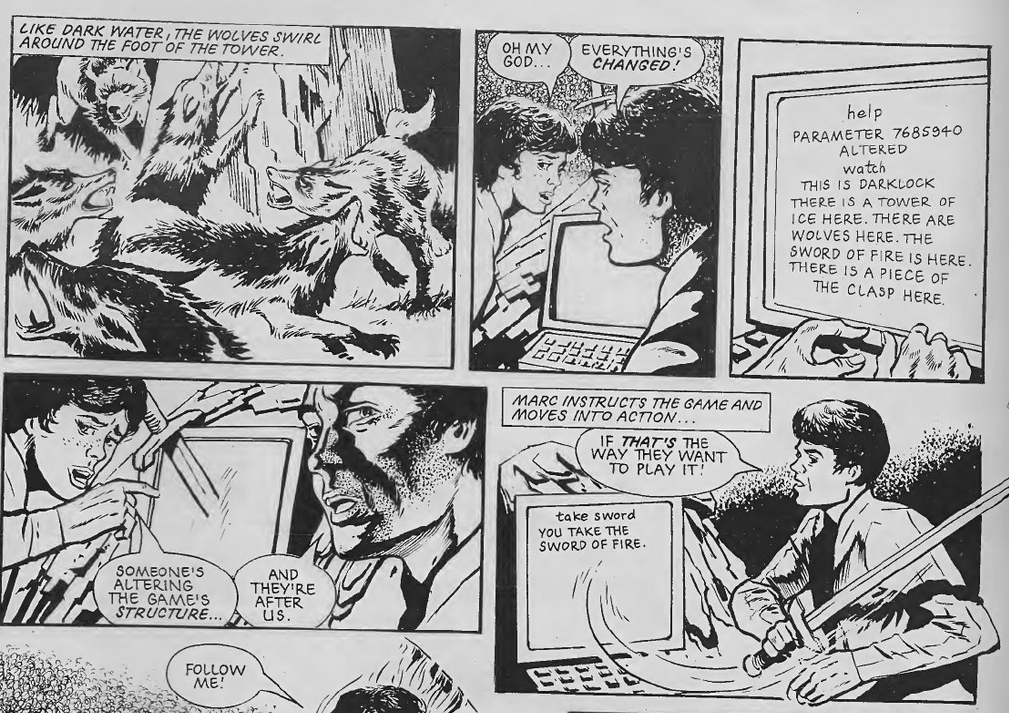
Five panels. Three on top, two on the bottom.
Panel 1: Wolves jumping about at the base of a tower.
Caption: Like Dark Water, the wolves swirl around the foot of the tower.
Panel 2: Marc and Jan looking worried in front of a computer screen.
Jan: Oh my god...
Marc: Everything's changed!
Panel 3: Close up on computer screen with words reading:
Help
Parameter 7685940 altered
watch
This is Darklock
There is a Tower of Ice here. There are wolves here. The Sword of Fire is Here. There is a piece of the clasp here.
Panel 4: Sword emerging from computer screen.
Jan: Someone's altering the game structure
Marc: And they're after us.
Panel 5:
Marc snatching the sword from the computer as computer screen reads:
take sword
You take the sword of fire.
Caption: Marc instructs the game and moves into action.
Marc: If that's the way they want to play it.

It ends up reminding me a bit of Doctor Who’s The Mind Robber. All rather fun in a YA kind of way.

There are also two humour strips. First is Virgin Games’ The Amazing Adventures of the Laughing Shark, where he goes around making silly jokes about their latest releases:
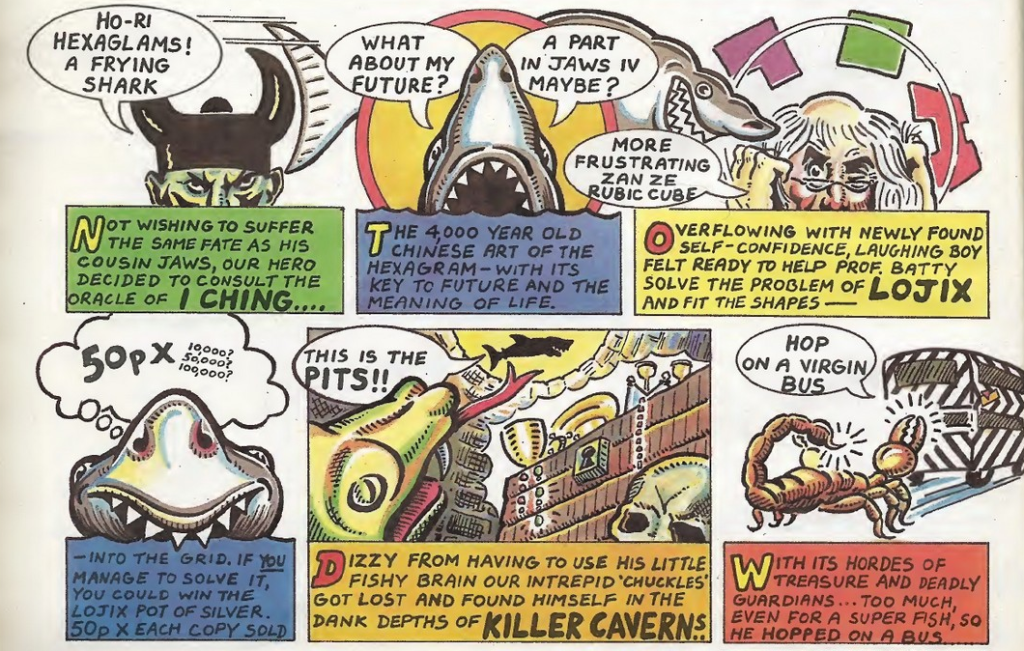
Six panels, three on top, three on bottom.
Panel 1:
Racist caricature of a chinese person saying:
Ho-Ri Hexagrams! A Frying Shark!
Caption: Not wishing to suffer the same fate as his cousin Jaws, our hero consults the I, Ching.
Panel 2: Laughing Shark with mouth open.
Shark: What about my future? A part in Jaws IV maybe?
Caption: The 4000 year old Chinese art of the hexagram - with its key to future and the meaning of life.
Panel 3: A frustrated looking professor with long white hair surrounded by moving shapes saying:
More frustrating zan ze Rubic Cuber
Caption: Overflowing with newly found self-confidence, laughing boy felt reading to help Prof Batty solve the problem of Lojix, and fit shapes.
Panel 4:
Close up of Laughing Shark thinking:
50px 10000? 50000? 100000?
Caption: Into the grid. If you manage to solve it you could win the Lojix pot of silver. 50p x each copy sold.
Panel 5: Laughing shark jumping over a pit filled with treasure and a hissing snake.
Laughing Shark: This is the Pits!!
Caption: Dizzy from having to use his little fishy brain our intrepid 'chuckles' got lost and found himself in the dank depths of Killer Caverns.
Panel 6: Scorpion chasing after a bus.
Laughing Shark: Hop on a virgin bus.
Caption: With its hordes of treasure and deadly guardian... too much, even for a super fish, so he hopped on a bus.

And finishing with The Adventures of Rom and Ram, about two tiny aliens who live inside a computer and fail to conquer Earth in silly ways:
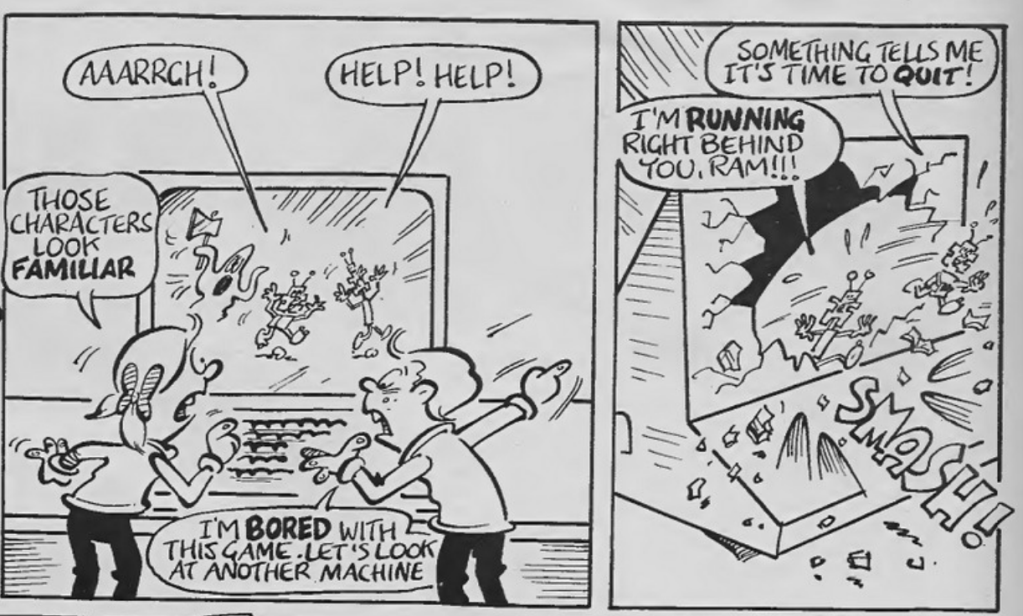
Two panels side by side.
Panel 1: Two kids watching a computer screen where Rom and Ram are running from an axe wielding ghost. 
Rom: Aaargh
Ram: Help! Help!
Girl: Those characters look familiar.
Boy: I'm bored with this game. Let's look at another machine.

Panel 2: Screen of computer smashing as Rom and Ram leap out.
Ram: Something tells me it's time to quit!
Rom: I'm running right behind you, Ram!!!

One for those who like the standard humour of British kids comics at the time.

Photonovel

As is often the case, science fiction is mixed with realism in these comics, with the Grange Hill-esque School for Software. Bev Jeavons is trying to win a competition for the best computer programme, but has to deal with the challenges of gender stereotypes, bullying and her own family not having much money:
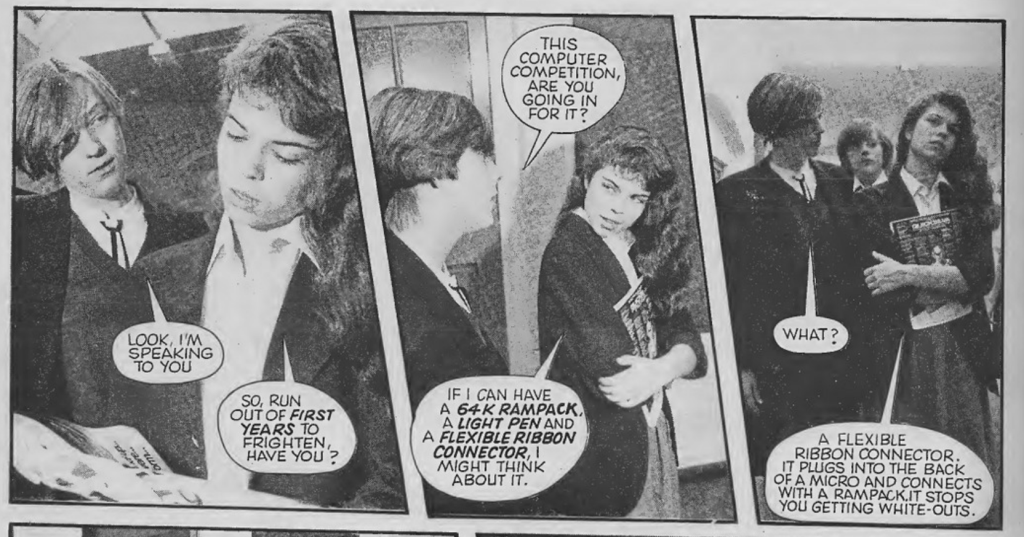
Three panels side-by-side:
Panel 1: Boy talking to Bev in the school corridor.
Boy: Look I'm speaking to you.
Bev: So, run out of first years to frighten, have you?

Panel 2: Same scene side view of boy and Bev
Boy: This computer competition, are you going in for it?
Bev: If I can have a 64K Rampack, a light pen and a flexible ribbon connector, I might think about it.

Panel 3: Boy and Bev walking down the corridor:
Boy: What?
Bev: A flexible ribbon connector. It plugs into the back of a micro and connects with a rampacks. It stops you getting white-outs.

I like the fact that it touches on issues that are, unfortunately, still common today and is engaging, even though I am not a huge fan of the photo novel subgenre.

Programming & Factual

Of course, for the computer fans, people would write in their own programmes for you to use. Here is one for a spaceship flying game Asteroids:
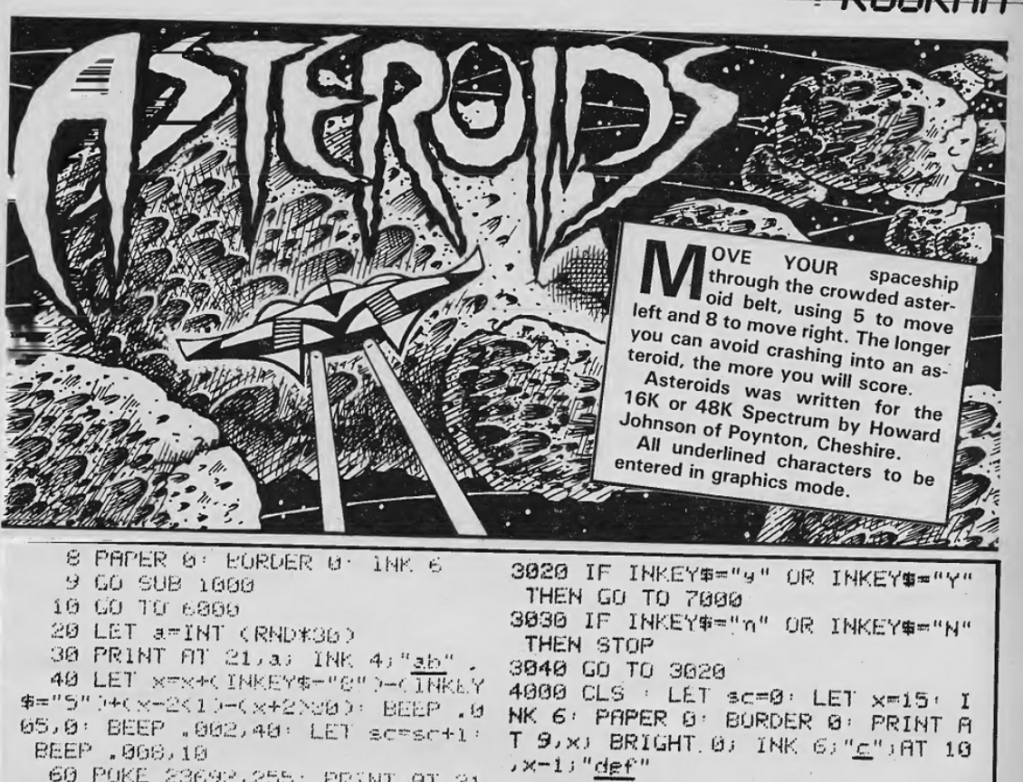
Programming for Asteroids, with caption:
Move your spaceship through the crowded asteroid belt, using 5 to move left and 8 to move right. The longer you can avoid crashing into an asteroid the more you will score.
Asteroids was written for the 16K or 48K Spectrum by Howard Johnson of Poynton, Cheshire.
All underlined characters to be entered in graphics mode.

And here is how to run an address book on the VIC–20:
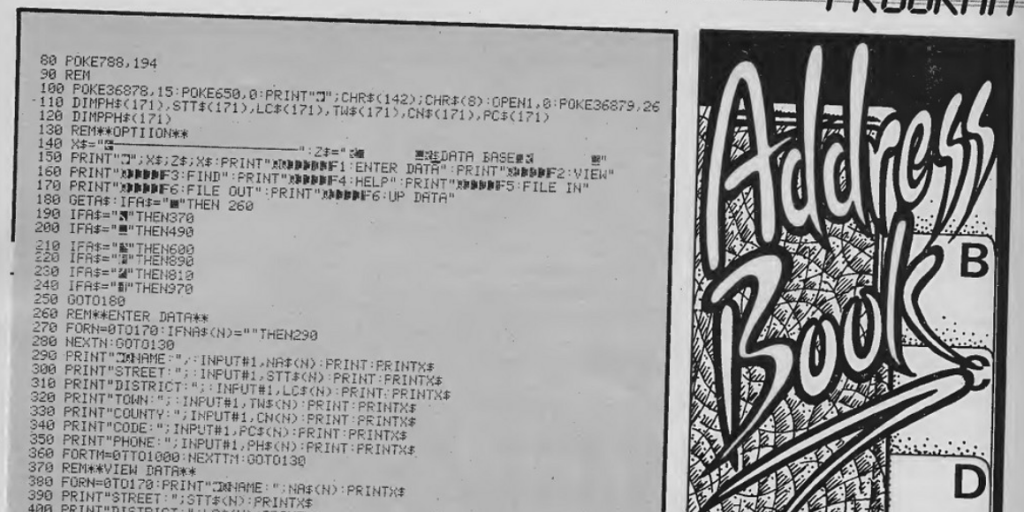
Programming instructions for Address Book.

How well either worked I am afraid I am unable to say.

There are also plenty of factual articles, such as covering the history of computing:
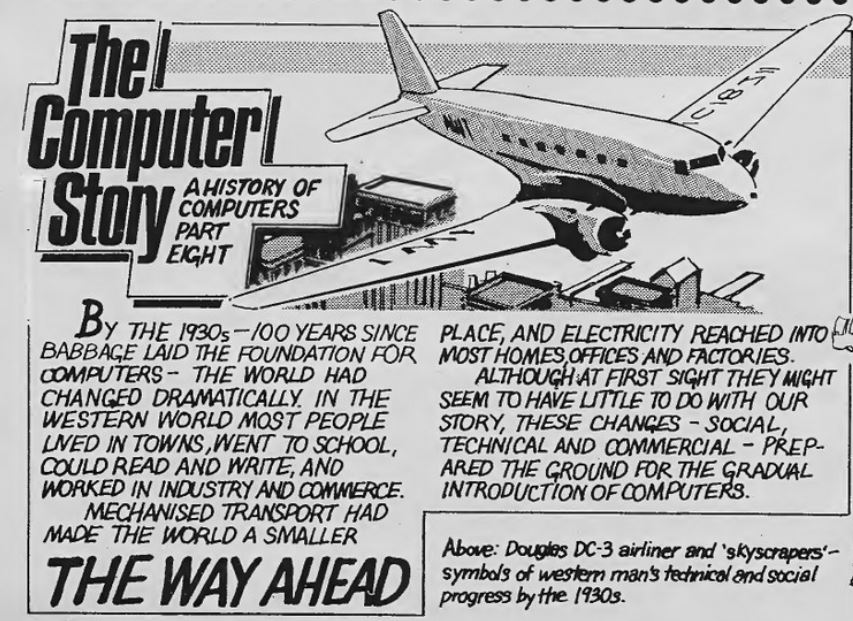
The Computer Story Part 8, illustrated by a DC-3 aeroplane.
By the 1930s, 100 years since Babbage laid the foundation for computers -  the world had changed dramatically. In the western world most people lived in towns, went to school, could read and write, and worked in industry and commerce.
Mechanises transport had made the world a smaller place, and electricity reached into most homes, offices and factoris.
Although at first sight they might seem to have little to do with our story, these changes - social, technical and commercial - prepared to ground for the gradual introduction of computers.

Or Arcade games no longer on the market:
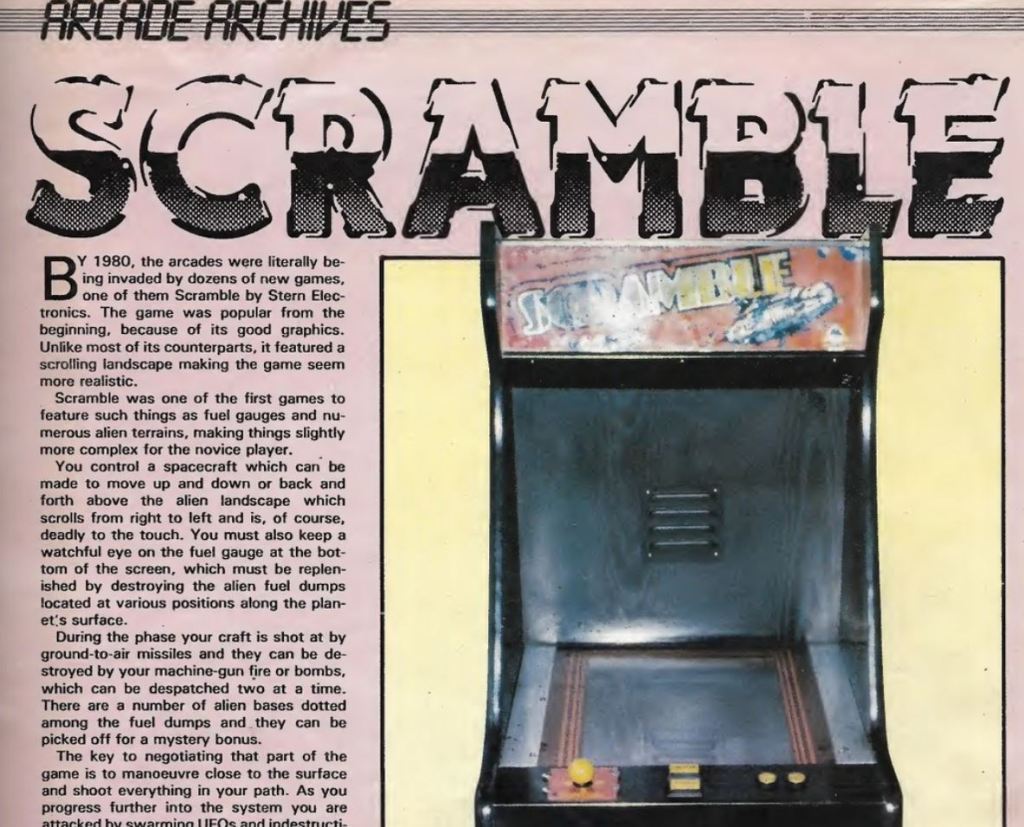
Arcade Archives Scramble.
Description of the Arcade machine with an image of it.

Game Over

I am always a fan of the genre trying new things, and this definitely feels like an interesting comic. I can see why I didn’t last a long time but one I enjoyed and will be certainly seeking out more issues of.

We continue with the world of strange cross promotion, with the bizarre Lyons Ice Cream comic, Whacko #1:
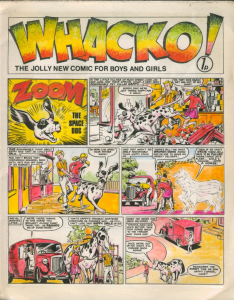
Whacko Issue #1

What will we make of this one? See you soon.

Leave a comment