
This month the randomizer has landed on the sports comic Scorcher from 1971. As a non-football fan, how will I fare with it?
The cover does a good job of displaying what the magazine is trying to be, illustrating a highlight of a recent cup match between Aston Villa and Manchester United.
For this is not just a fiction comic book, but has as much focus on being an informational magazine for the young soccer fan.
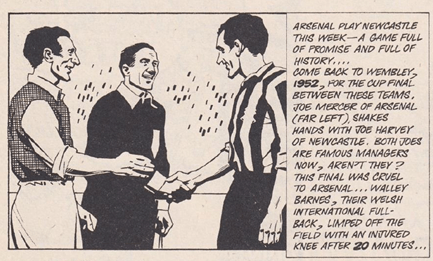
These include features such as Match-Day Highlights, which features upcoming important matches along with their history:
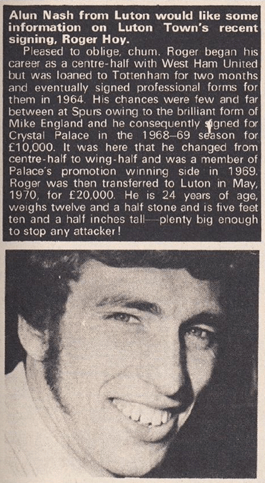
The Goal-Post where readers can either send jokes or request answers to their football related queries:
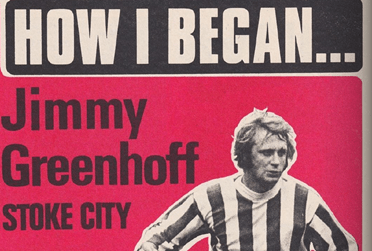
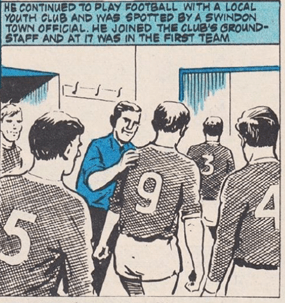
And How I Began… with interviews with current players on their careers:
It is also interactive with the readers, asking for features such as their most memorable match:

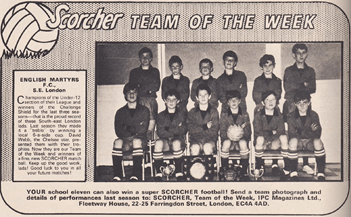
And highlighting young teams:
However, I am predominantly here to discuss the fiction. So how is this?
When I got randomly assigned this one I was worried it was going to be getting a dozen versions of Roy of the Rovers. But only Bobby of the Blues is a straight soccer tale.
This strip centres on Bobby Booth, striker for Everpool City. In this episode they are due to play away against Palmetto in the European Cup. Everyone thinks it will be a walk over but Everpool’s manager, Vic Crosby, believes that Palmetto have a strong home field advantage:
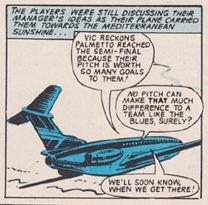
It turns out Palmetto’s stadium is boiling hot and has no turf on it. When Everpool go to play they struggle to adjust their playing style to the new arena:

And with the ground so hard the goalkeeper, Ted, cuts his knees:

When Ted tries to change into trousers, Palmetto get a clear run to the goal and we end of the cliffhanger of if Palmetto will score:

I have to say, I was engaged throughout. It is a simple scenario, but it built the tension nicely and has strong artwork emphasizing the action whilst keeping the characters clear and separated.
The rest of the strips are more unusual sport stories. Combining football with the kind of setups you would see in most boy’s adventure comics.
First up is the The East Mound Mob, about a rough and ready six-a-side squad that get themselves involved in scrapes. In this one the Mob have hidden a letter proving their friend innocent of bribery in a football. In a game with The Crimea Street Gang, this ball gets kicked into a bush and mixed up with a whole bunch of others:
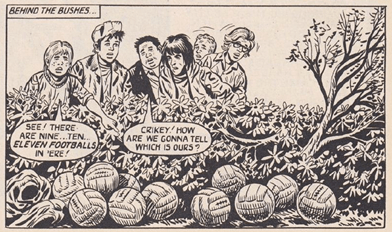
However, when they try to take the balls to the authorities they find none of them contain the letter and it ends up instead in the hands of The Crimea Street Gang:
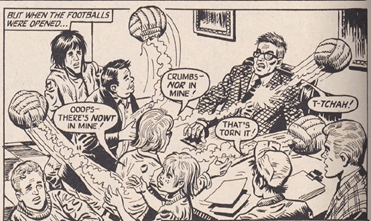
It is hard to get a good grip on this trip as we are in the middle of the story and I don’t get a good sense of the characters from this one installment. Reasonable enough but didn’t grab me.
Next up is Charlie Ironsides about a football playing robot. I am not sure having your centre-midfielder as a automaton is strictly within FA rules, but it seems to work well for Hepton Athletic:
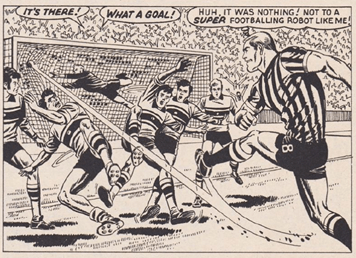
Whilst they are doing well on the pitch, their manager Bill Harcourt is being blackmailed by a criminal organization called The Green Triangle. Charlie works out what is happening and steals the wheels off Bill’s car and drives off with them:
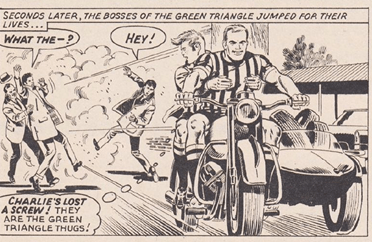
Opening up the wheels they find stolen diamonds inside:

This is a very fun strip, in style and content it reminds me a lot of Eagle’s Iron Man, which is one of my favourites from that title.
The text story is pretty similar, Forward From Rome being about a Roman gladiator called Plexus, who time travels to the present day and plays for Glumly Town.
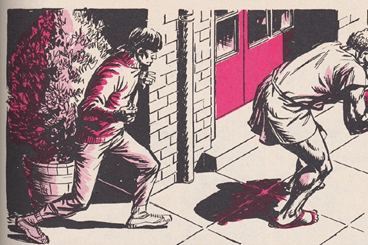
In this week’s installment they travel to play Dockport for a place in the cup final. There Plexus is gassed by a tampered football and shoved into a museum by unscrupulous people who want Dockport to be in the final over Glumly Town. However, Plexus is discovered by a fan club of gladiators who have also time travelled to see him.
It is all very silly fun. I am not convinced by the idea a Roman gladiator would have the necessary skills to become a successful centre-forward for a 20th century third division team but it is all so bizarre I couldn’t help but be drawn along with it. The kind of thing I would have expected to watch on CBBC as a kid.
Continuing on the theme of the fantastical we have Billy’s Boots. This involves young Billy Dane who finds a pair of boots which had belonged to a former football star “Dead-Shot” Keen. These seem to give him the playing ability of Keen whenever he wears them:
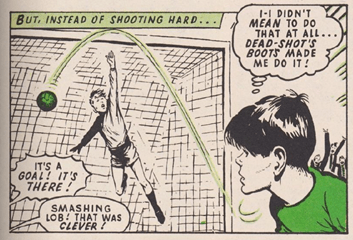
This week he realizes he is not just playing like Keen, his life is starting to resemble Dead-Shot’s:
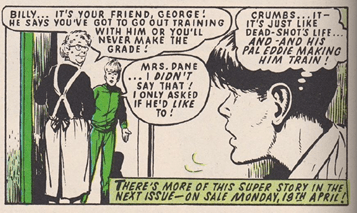
This story seems less focused on the adventure or excitement if the game but more on the mystery of what is happening to Billy. As such it does represent a nice change from the high pace of the other stories in the magazine. But, as a bit of a slow burn and with only two pages to tell it each week, it is less instantly engaging.
Quite a number of these are about unusual people suddenly finding themselves as football stars. One such strip is King of Football. Here the young king of Moravia, Rudolph Maximillian Rantzberg, is saved from communist assassins and convinced to sign on to Thornton Villa. The boy kind turns out to be quite a football player:

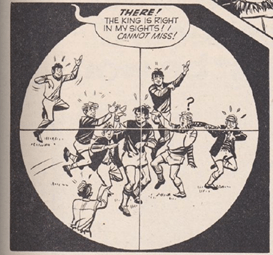
However, the story is more concerned with him surviving the assassins, who, this time, try to shoot him during the match:
In order to survive this attempt Rudolph gets his giant bodyguard to convince the announcers to read out an announcement in Moravian to lure out the assassins:
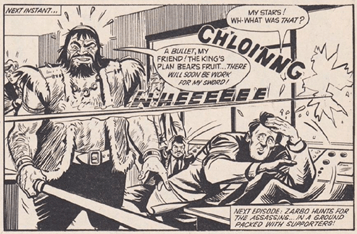
This could have been a very dark storyline but the absurdity of the situation and the presence of Zarbo help keep the entire thing feeling light and fun even as bullets are flying around everywhere.
Another case of unusual players is The Amazing Strollers. Here the titular theatrical family are discovered to have an aptitude for football, and struggling side Cranmere want them to sign for them:
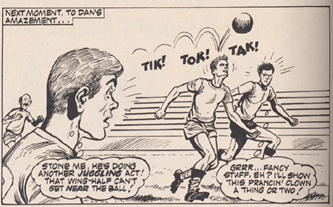
But others do not want them to leave showbusiness:
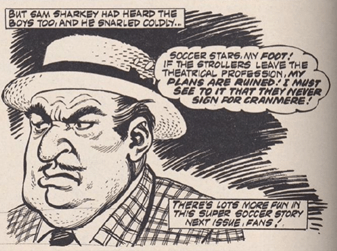
This manages to strike the right balance between comedy and storytelling to keep it enjoyable.
One that falls over in this aspect is Manager Matt, a “funny” strip that definitely doesn’t manage that for me. In this one a Witch Doctor from Africa takes over to help the club:
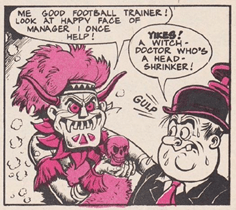
However, his magic ends up just causing the game to be abandoned:
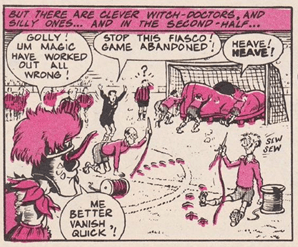
Now I know this story is from over 50 years ago and humour is subjective but I just find this offensive and totally unfunny. Silly in a ridiculous and based on colonialist ideas that should have already have been well out of date by this point.
The final fiction strip is one I do not know quite what to make of. Lags Eleven are a prison football team. Five of them were scheduled for release but the governor and “Brilliant Genius” framed them to keep on the team.
In protest they start scoring own goals. They are then promised their freedom but Brilliant is determined they must lose so they stay in prison and kept on them team:

I have trouble with this one. I don’t’ really have a good handle on Brilliant’s motivations and I found the artwork much weaker than in the rest of the magazine. I have read it through half a dozen times now and I am still scratching my head as to what is going on. Perhaps it is one that works better in a longer serial.
There are a couple of other pieces that I will just mention in brief, quiz comic Spot The Star where you have to use the clues to guess the footballer:
And two ads, Super Mousse, a superhero comic advertising the titular chocolate bar:
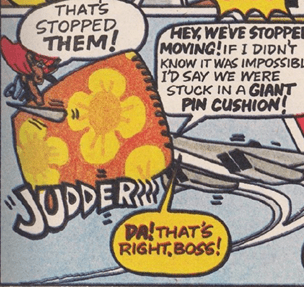
And How They Captured Sound. a history strip chronicling the development of the record player to advertise a competition for Philips inside Ready Brek:

In spite of some weaker stories, I found myself rather impressed with this magazine myself. I can only imagine how great it must have been to young football fans in the pre-internet age.
Next month, we will be going to the end of the 20th century with Warhammer Monthly #11 from 1999:
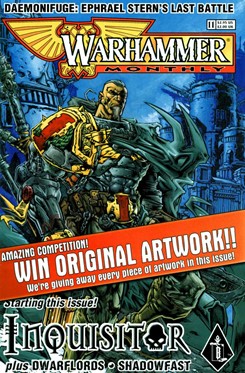
Whilst I played Warhammer by this point and read some of the novels, I didn’t pick up the comic book. We will have to see what is in store for us in March.
 Corner Shop Time Stop